
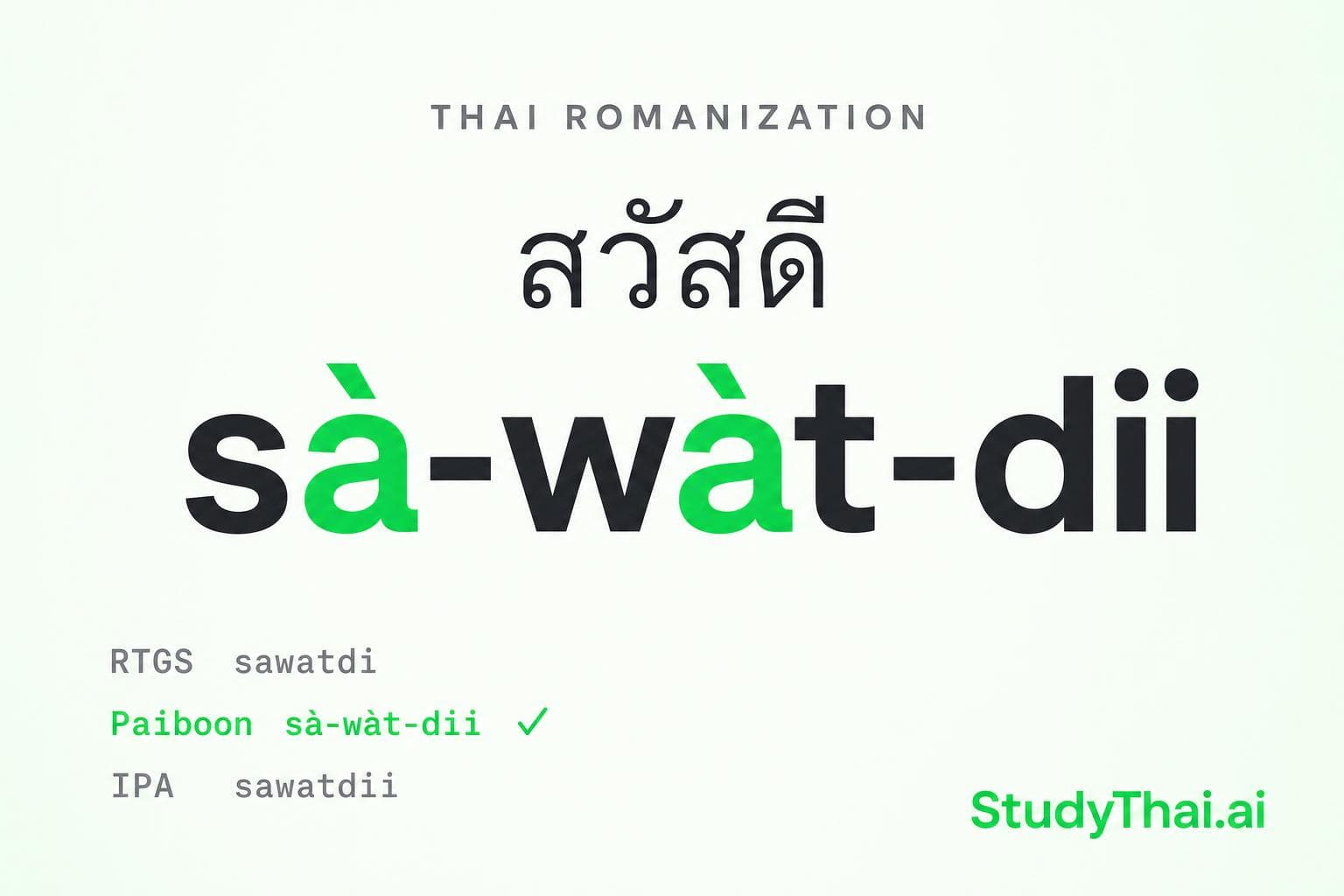
How to Read Thai Romanization: RTGS vs Paiboon vs IPA Explained
If you're learning Thai, you've hit this confusion: one textbook writes sawatdi, a dictionary writes sà-wàt-dii, and your translation app gives a third spelling — which one is right? The problem isn't you. Thai simply doesn't have one standard romanization. This guide clears it up: which systems exist, why they disagree, and how to read them so you actually pronounce words correctly.
By the end, you'll be able to look at any Thai romanization and instantly tell which system it's from, whether it's reliable, and how to say it.
Why does Thai need romanization at all?
Thai is a phonetic script — in theory, once you learn the 44 consonants and 32 vowels, you can read any word. But for beginners the Thai alphabet is unfamiliar, so nearly every course first writes Thai in Latin letters (romanization) as a bridge.
That bridge is exactly where the trouble starts: there is no single correct way to romanize Thai. Different systems were built for different purposes, and they look nothing alike.
The three main Thai transliteration systems
Almost all Thai romanization you'll encounter comes from one of these three:
| System | Full name | Marks tones? | Distinguishes vowel length? | Used for |
|---|---|---|---|---|
| RTGS | Royal Thai General System | ❌ No | ❌ No | Road signs, place names, official docs |
| Paiboon | Paiboon-style transcription | ✅ Yes | ✅ Yes (doubled) | Practical courses, learning apps, dictionaries |
| IPA | International Phonetic Alphabet | ✅ Yes | ✅ Yes (with ː) | Linguistics, academic work |
The same word ขอบคุณ ("thank you") across all three:
| System | Spelling | The catch |
|---|---|---|
| RTGS | khopkhun | No tones, no length — you can't pronounce it accurately from this |
| Paiboon | kɔ̀ɔp-kun | Tones, length, and syllables are all clear |
| IPA | /kʰɔ̀ːp kʰun/ | Most precise, but the symbols are unfamiliar to most learners |
RTGS: looks simple, trips you up
The Royal system is Thailand's official standard — it's what you see on Bangkok street signs and metro stations. But to keep spellings tidy, it deliberately drops tone and vowel-length information — the two things that matter most for Thai pronunciation. RTGS is fine for recognizing place names, but not for learning to speak: read khopkhun aloud and your tones will almost certainly be wrong.
IPA: most accurate, steepest learning curve
The International Phonetic Alphabet can describe any language precisely, Thai included. But /kʰɔ̀ːp kʰun/ — with its extra symbols and the ː length marker — isn't friendly to learners without a linguistics background.
Paiboon: the practical choice for learners
Paiboon-style transcription (popularized by Benjawan Poomsan Becker's course series) is a middle ground built for learners: it keeps the crucial tone and length information, but uses ordinary Latin letters plus a few intuitive conventions, so you don't have to learn a symbol set first. StudyThai uses Paiboon-style transcription throughout — learn the rules below and you can read every transcription in our lesson cards and dictionary.
How to read Paiboon-style transcription
Paiboon looks like English, but a few key conventions differ from English — miss them and you'll mispronounce words.
1. dt and bp are not typos
This is where English and Chinese speakers stumble most. Thai has a set of "unaspirated" stops with no exact English equivalent, so Paiboon invented dt and bp for them:
| Spelling | Thai | Actual sound | Don't read it as |
|---|---|---|---|
g | ก | between English g/k (unaspirated) | not the hard aspirated "k" |
dt | ต | between English d/t (unaspirated) | not d, not t |
bp | ป | between English b/p (unaspirated) | not b, not p |
d | ด | voiced d | |
b | บ | voiced b |
Compare with the aspirated versions: t (ท, aspirated, like the t in "top") and dt (ต, unaspirated) are two different consonants — mix them up and the meaning changes.
2. Long vowels are doubled
Paiboon shows long vowels by doubling the letter instead of using IPA's ː:
ashort →aalong (e.g.maa, "come")ishort →iilongushort →uulongɔshort →ɔɔlong
Vowel length distinguishes meaning in Thai — get it wrong and it's a different word.
3. Tones: little marks on the vowel
Paiboon places the tone mark right on the vowel, so you can see at a glance which tone to use:
| Mark | Tone | Example |
|---|---|---|
| (none) | mid | maa |
à | low | sà |
â | falling | châat |
á | high | nák |
ǎ | rising | kǎo |
To master the tones themselves, see the 5 Thai tones and consonant classes & tone rules.
4. Syllable and word boundaries
- Within a word, syllables are joined with a hyphen
-:sà-wàt-dii(สวัสดี, "hello") - Between words, a space separates them:
kɔ̀ɔp-kun kráp(ขอบคุณครับ, "thank you")
This convention shows you where one full word ends and the next begins.
Paiboon quick reference
| Type | Notation | Example |
|---|---|---|
| Unaspirated mid consonants | g dt bp | glâi (near, ใกล้) |
| Long vowels | doubled aa/ii/uu | maa (come, มา) |
| Tones | à â á ǎ + unmarked | nák-rɔ́ɔng (singer, นักร้อง) |
| Syllable join | - | sà-wàt-dii |
| Word separator | space | mii sà-dtì (mindful, มีสติ) |
Why you still mispronounce words from romanization: 3 common traps
- Treating RTGS as a pronunciation guide: RTGS marks no tones, so reading
sawatdileaves the tones to guesswork. For pronunciation, insist on transcription with tone marks. - Blurring vowel length:
khao(short) andkǎao(long + rising) are different words. Don't ignore the doubling. - Mixing systems: some resources flip between RTGS and Paiboon inconsistently. That inconsistency is the real reason romanization "looks messy" — picking one consistent notation matters far more than which system it is.
Common-word reference table
Here are some high-frequency words in Paiboon notation (the spellings StudyThai's engine verifies word by word). Note the tones and vowel length:
| Thai | English | Paiboon |
|---|---|---|
| สวัสดี | hello | sà-wàt-dii |
| ขอบคุณ | thank you | kɔ̀ɔp-kun |
| มีสติ | mindful / conscious | mii sà-dtì |
| นักร้อง | singer | nák-rɔ́ɔng |
| ชาวต่างชาติ | foreigner | chaao-dtàang-châat |
| สมัครงาน | apply for a job | sa-màk-ngaan |
Note that
มีสติreads as two words,mii sà-dtì(มี "have" + สติ, a Pali loanword) — not one mangled blob. These Pali/Sanskrit compounds are exactly where resources most often get the romanization wrong. To understand final sounds and irregular spellings, see Thai's 8 final sounds and special pronunciation rules.
FAQ
Q: Which system should I learn?
Use Paiboon (the kind with tone marks) for pronunciation, know RTGS just for place names, and skip IPA unless you need it. For most learners, one practical tone-marked, length-aware notation is enough.
Q: Should I rely on romanization forever?
No. Romanization is a transitional bridge — the goal is to read Thai script directly as soon as possible. Learn the alphabet alongside the romanization, and once syllable structure clicks, drop the crutch.
Q: Why doesn't StudyThai use IPA?
Because for learners, Paiboon-style transcription strikes a better balance between accuracy and approachability: it keeps the essential tone and length information without requiring you to learn an unfamiliar symbol set first.
Summary
Thai romanization is messy — and it's not your fault. RTGS, Paiboon, and IPA simply coexist, built for different purposes. Remember three things:
- Recognizing place names? RTGS is fine — but don't learn pronunciation from it (no tones).
- Learning pronunciation? Insist on Paiboon-style notation with tone marks and doubled long vowels.
- The real enemy is mixing systems — pick one consistent notation and stick with it.
Learn Thai with consistent, verified phonetics
StudyThai uses consistent Paiboon-style transcription everywhere — lesson cards, dictionary, and examples are all verified word by word, so you read every sound right from day one.


